Steam Social Deduction Fest 2026: Dates & Games List
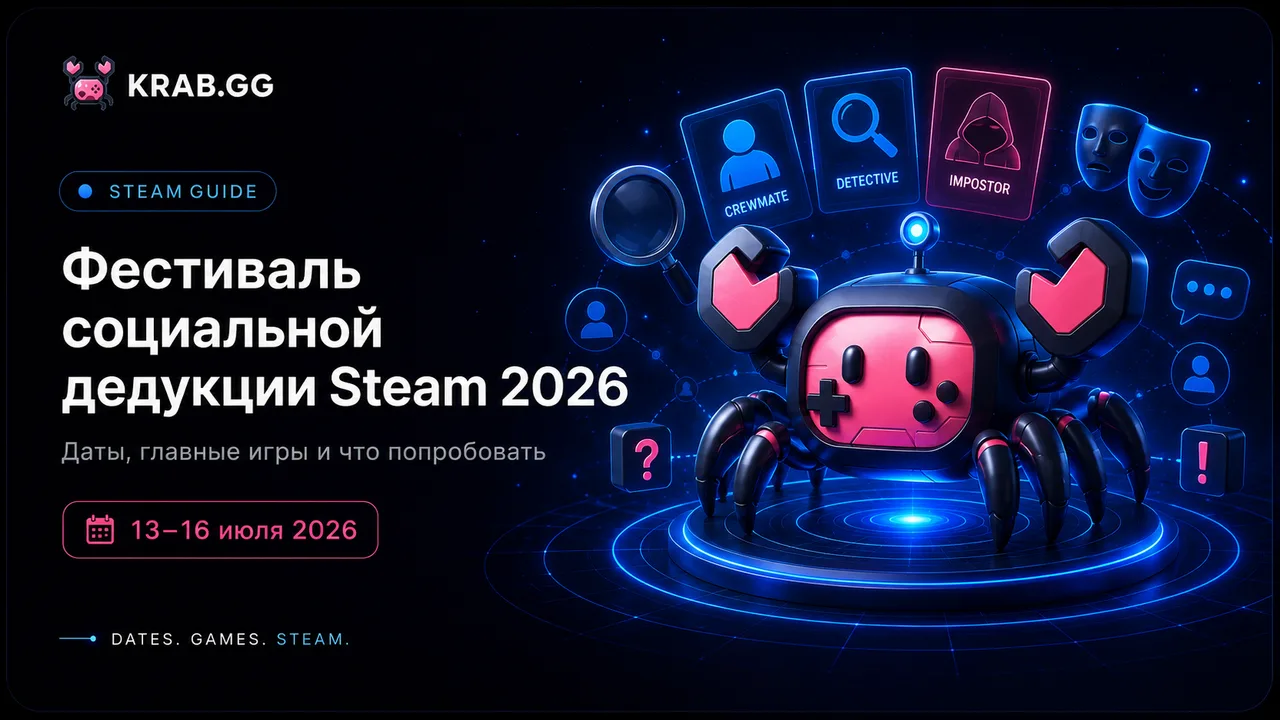
From July 13–16, 2026, Steam runs its Social Deduction Fest — a showcase of traitor-hunting games with discounts and demos. Here are the dates, the genre explained, a lineup of 8 games, and one payment quirk for Russian players.
Contents
- Social Deduction Fest 2026 at a glance
- What the festival is and when it runs
- How the deduction fest differs from a regular sale
- What "social deduction" actually means
- What to play: a lineup of 8 genre games
- How to pick a game for your group
- What to look for during the festival
- Where the festival sits in Steam's calendar
- How to prepare for the festival if you're in Russia
- Is the festival worth waiting for
Barely closed the cart after the Summer Sale, and Steam already has a new reason to spend money. The Summer Sale wrapped up on July 9, 2026, and just days later the Social Deduction Fest kicks off — a themed showcase built around one job: find the traitor in your group. This isn't "the whole catalog on sale" — it's a narrow but genuinely fun genre built on lying, voting, and getting caught. And with Valve's Train Fest lined up right after, summer 2026 is shaping up to be a surprisingly expensive season.
Social Deduction Fest 2026 at a glance
- Dates — July 13–16, 2026; kickoff around 8:00 PM Moscow time on July 13.
- Format — a genre-themed showcase: discounts on traitor games, demos, streams, and curated bundles for group play.
- Genre — social deduction: spot the impostor among players through discussion, lies, and voting.
- Steam calendar slot — right after the Summer Sale (ended July 9) and right before Train Fest (July 20–27).
- Note for Russian players — direct ruble payments on Steam aren't available, so it's worth topping up your wallet ahead of time.
What the festival is and when it runs
Steam's Social Deduction Fest 2026 runs July 13–16, with kickoff expected around 8:00 PM Moscow time on July 13 (Steam sales and fests typically go live at that hour). It's a themed event centered on games about deception and hunting down hidden traitors: the storefront gathers discounts, demos, and streams around the genre. According to Steamworks documentation, the fest is officially part of Steam's 2026 event calendar.
It only lasts four days — noticeably shorter than the Summer or Autumn Sale, which stretch over two weeks. That's typical for Steam's themed festivals: they cover one narrow genre and don't stick around long, but they're great for surfacing games that would otherwise get buried under thousands of cards in a big general sale.
How the deduction fest differs from a regular sale
The main difference is scope: a seasonal sale touches nearly the entire Steam catalog, while a themed festival covers just one genre. The Summer, Autumn, and Winter Sales cut prices on tens of thousands of games at once, from indies to major releases, with no genre focus. The Social Deduction Fest works differently — only games about traitors, lies, and voting make it onto the storefront, and the rest of the catalog is barely touched.
The second difference is the content surrounding the discounts. At themed festivals, Valve usually rounds up demos of new genre projects, runs streams with developers and the community, and sometimes bundles several genre games together with stacking discounts. That's not typical for a big sale, where the focus is almost entirely on price.
And the third difference is duration. The deduction fest runs four days, while a big sale runs about two weeks. Miss the July 13–16 window, and you'll likely have to wait until next year for a similar genre event — Valve updates the festival lineup annually.
What "social deduction" actually means
Social deduction is a multiplayer genre where some players are secretly "traitors" while everyone else tries to expose them through conversation, observation, and voting. The classic example is Among Us: the crew runs tasks while one or two impostors quietly sabotage and eliminate people, and the crew can only win by agreeing on who's guilty — through talk alone.
The whole appeal comes from an information gap: nobody has the full picture. Every accusation is a bet, every alibi is a story you need to sell convincingly. Either you catch the lies by spotting small inconsistencies, or you lie well enough to be believed yourself.
The game loop is almost always the same: a round of activity (tasks, exploring, a regular match), then a discussion break, then a vote that "ejects" one of the suspects by majority. Guess wrong, and you've lost an innocent player while giving the traitor an edge. Guess right, and you're one step closer to winning. That repeating rhythm is what keeps rounds tense even after dozens of matches with the same group.
The genre's roots go back to tabletop games like Mafia and Werewolf, where a moderator assigns roles, players "kill" at night, and the group votes out suspects during the day. Plenty of digital titles reference these origins directly — MINDNIGHT, for instance, was built with Werewolf and The Resistance as direct inspirations. Steam basically moved this age-old trust-and-betrayal mechanic online.
Over time the genre split into a few sub-genres: cooperative-detective style (Among Us, Goose Goose Duck), survival and harsher variants (Project Winter, Secret Neighbor), and horror-shooter hybrids (Deceit 2, First Class Trouble), where betrayal is layered on top of shooting or fleeing. Which game fits your group usually comes down to which sub-genre you're after — calm detective work or something with more edge and adrenaline.
What to play: a lineup of 8 genre games
Here's a rundown of games that will almost certainly show up on the festival storefront. Some of them are free, which is handy if you're gathering a group of newcomers — no one has to be talked into paying.
Game | Paid / Free | In short |
|---|---|---|
Among Us | Paid (cheap) | Genre classic: crew vs. impostors, tasks and votes |
Goose Goose Duck | Free-to-play | The "goose" take on Among Us for up to 16 players, lots of roles |
Town of Salem 2 | Free-to-play | 7–15 players, over 50 unique roles, deep mechanics |
Deceit 2 | Free-to-play | First-person horror shooter: the innocent vs. the infected |
MINDNIGHT | Free-to-play | Cyberpunk deduction inspired by Werewolf and The Resistance |
Project Winter | Paid | Survival in the snow for 8 players, with betrayal built in |
Secret Neighbor | Paid | Hello Neighbor spin-off: kids vs. a hidden traitor |
First Class Trouble | Paid | AAA-level polish, a spaceship setting with a glitching AI |
If you want a free start with friends, go for Goose Goose Duck, Town of Salem 2, Deceit 2, or MINDNIGHT — all four are free-to-play. Among Us costs a small amount on PC but is free on mobile, which is handy if someone wants to join in from their phone.
Secret Neighbor and First Class Trouble cost a bit more than the genre's entry price, but they also look noticeably pricier: the first brings Hello Neighbor's atmosphere to a children's mansion with a hidden traitor, the second is set aboard a spaceship with a malfunctioning AI and is polished close to a major studio release. Both work well once your group has burned through Among Us and wants something more serious.
Deceit 2 and MINDNIGHT stand apart: the first is a horror shooter where the innocent run from the infected, the second is a cyberpunk detective game with no shooting at all, just dense rounds of negotiation. If your group isn't up for jump scares, start with MINDNIGHT or Town of Salem 2 instead — everything there is settled with words, not reflexes.
How to pick a game for your group
The right pick depends less on ratings and more on three practical things: how many people you've got, whether they're willing to pay, and how much tension the group can handle.
- A group of 8–10, all beginners — go with Among Us or MINDNIGHT: the rules click after one round, and MINDNIGHT's free entry sidesteps the "why pay for a game we don't know" question.
- A big group, 10+ people — Goose Goose Duck (up to 16 players) or Town of Salem 2 (7–15 players, 50+ roles) work well: the more people involved, the better the role system holds up.
- Looking for atmosphere, not just logic — check out Secret Neighbor or First Class Trouble: what matters there isn't just correct reasoning but the mood of the whole thing.
- Not afraid of jump scares or gunfights — Deceit 2 adds adrenaline: standard deduction turns into a horror runner here.
- Into survival and hardcore co-op — Project Winter gives you a snowy map, limited resources, and betrayal as part of the strategy, but be ready for a less friendly new-lobby community.
If you're on the fence, start with a free game. All four free-to-play titles on this list mean nobody has to worry about "what if I don't like it," and you can get the whole group playing in one evening without spending anything.
What to look for during the festival
A themed festival works differently from a big sale. There are three things worth watching for:
- Genre discounts. Noticeable price cuts on popular traitor-themed titles. Valve publishes the exact percentages when the fest goes live — they'll show up right on each game's storefront card.
- Demos. A chance to try new multiplayer deception games before buying — useful so your whole group isn't buying blind.
- Themed bundles. Some festivals let you grab several traitor-genre games together with a stacking discount — a better deal than buying them one by one.
There are also streams running on the festival pages: tactic breakdowns, "how to lie properly" guides, and community matches. Handy if you want to get up to speed on the meta before your first round with friends.
One more tip if you're planning to gather a group ahead of time: add the games you're interested in to your Steam wishlist before July 13. That way, once the fest goes live, you won't have to dig through the catalog for the right cards — the discount notification comes automatically, and you can buy in a couple of minutes while everyone else is still figuring out who's playing what.
Demos are best tested with part of your group, not solo — the genre is built entirely around group dynamics, and it's nearly impossible to judge whether a specific game will click based on a single-player run. Line up two or three friends to try a demo together — it'll take less than an evening, and the group's buying decision will be a lot more confident.
Where the festival sits in Steam's calendar
Summer 2026 is packed for Steam: three events back to back in a single month. If you're mapping out the full 2026 Steam sale calendar, the chain looks like this: Summer Sale (June 25 – July 9) → Social Deduction Fest (July 13–16) → Train Fest (July 20–27). This lines up with the 2026 Steam sale schedule reported by DTF.
Three events in one month is a record pace even for Steam, which already never misses a chance to remind you about discounts. For your wallet, honestly, it's a bit of a gauntlet — barely close one sale and the next one opens. If you're planning to take part in all three, it makes sense to top up your balance once with some buffer, rather than running to a payment service every few days.
If you keep an eye on sales all year, it's worth having the full events calendar handy: autumn and winter sales will follow the deduction fest and Train Fest. And for the most relevant summer coverage, check our piece on the Steam Summer Sale 2026 dates and games.
How to prepare for the festival if you're in Russia
Since the event only lasts four days, it's worth sorting out the logistics beforehand rather than scrambling on day one. Here's what makes sense to do before July 13:
- Get your group together. Agree in advance on who's playing what — the genre is built entirely around group dynamics, and most of these games don't work solo.
- Download the free titles now. Goose Goose Duck, Town of Salem 2, Deceit 2, and MINDNIGHT cost nothing — install them any time, no need to wait for the sale.
- Add paid games to your wishlist. That way the discount notification arrives automatically, and you won't be hunting for the right card in the catalog during the busiest part of the fest.
- Sort out your wallet balance — and this is where there's a catch most festival roundups skip.
You can't top up your Steam wallet in rubles directly from a Russian card — the currency restrictions haven't gone anywhere, and if you open the festival storefront on July 13 with an empty balance, buying that discounted game just isn't going to happen.
So it's worth topping up your balance ahead of time, before the fest starts, instead of burning precious sale hours on payment issues. Through KRAB.GG, you can top up your Steam wallet using just your account login, no password required, starting from 50 rubles. Payment goes through local methods — Russian cards, SBP, or TON-network crypto — and the funds land on your balance instantly. The final amount and any fee are shown in the bot and at checkout before you confirm.
If you want more detail on payment methods, we've got a separate detailed guide on topping up Steam from Russia covering all the working options. General questions about timing, limits, and security are covered in our FAQ section.
Is the festival worth waiting for
Yes, if you like playing with friends and don't mind cheap (often free) traitor-hunting games. Steam's Social Deduction Fest 2026 runs just four days, July 13–16, so it's worth gathering your friends, downloading a couple of free-to-play titles, and sorting out your wallet balance ahead of time.
Planning to buy something during the festival? Top up your Steam balance on KRAB.GG in advance so you're ready the moment the sale opens — and spend your time hunting traitors, not wrestling with a payment system.
Prices and exchange rates fluctuate — check the payment page for current figures. When using Steam, follow the platform's rules. This article is for informational purposes only.
FAQ
When does Steam's Social Deduction Fest 2026 run?
The festival runs July 13–16, 2026. Kickoff is expected around 8:00 PM Moscow time on July 13, since Steam sales and festivals typically go live at that hour.
Which social deduction games are free to play?
Four popular titles are free-to-play: Goose Goose Duck, Town of Salem 2, MINDNIGHT, and Deceit 2. Among Us costs a small amount on PC but is free on mobile.
How do I pay for a Steam purchase from Russia?
You can't top up a Steam wallet directly in rubles from a Russian card due to currency restrictions, so people use third-party services instead. Through KRAB.GG, you top up by account login with no password required, pay with Russian cards, SBP, or TON-network crypto, and the funds land instantly.
Do I need Telegram Premium for the festival games?
No, Telegram Premium has nothing to do with Steam — they're separate services. All you need to join the festival is a Steam account, and a topped-up wallet if you plan to buy anything.
Will I have time to top up my Steam wallet before the festival starts?
Yes, if you do it ahead of time. Topping up through KRAB.GG lands on your balance within minutes, so you can even do it on the day the fest starts — but it's safer to prepare your balance before July 13 so you don't waste any sale time.
We cover Telegram Stars, Premium and payments — clearly and to the point
11 min read